Austin Youth Basketball · Middle School
Tryout cuts are 90 to 120 days out.
What your kid fixes between now and then is what the coach sees.
Small-group training built on the USA Basketball and FIBA curriculum — then taken past it. Expert shot coaching. How to actually score. And the mindset work almost nobody does.
Venmo me $220 @Christopher-Corbett-13 or Zelle @ 512-921-4444. Note player name and grade, your name and phone number.
Full curriculum below. No email required.
Coached under USA Basketball’s Don Showalter
FIBA masters competitor · Trains European clubs
~100 players placed D1 · D2 · D3 · NAIA
01 — The problem
Two ways to
waste two years
Most middle school training is a guy with a whistle and a bag of drills.
Nobody wrote it down. Nobody knows what good looks like. Your kid sweats for an hour, does a hundred layups, goes home. Next season a different coach teaches the same skill with different words.
By ninth grade your kid has heard six versions of the same thing and trusts none of them. Then they walk into tryouts and the varsity coach burns three weeks fixing footwork.
That’s not your kid. That’s a curriculum problem.
Nothing stacks.
The other option isn’t better
The franchise down the road has a system, alright. It also has investors, a regional director, and a spreadsheet with a number on it for how many kids need to be in that gym at 6pm.
They’ll run him through factory drills with twenty other kids, high-five everybody for energy, and send him home sweaty. Nobody stopped him. Nobody corrected him. Nobody explained anything.
Sweaty isn’t the product. One option is disorganized. The other is organized around the wrong thing.
02 — The turn
There’s already a right answer.
Almost nobody teaches it.
USA Basketball publishes a full player development curriculum. FIBA publishes coaching manuals used in 215 countries. Both are free. We teach them — and that’s our floor, not our ceiling.
USA Basketball and the NBA adopted FIBA rules outright for grades 9-12. The words we teach a sixth grader are the words their varsity coach will use. Split line. Flat triangle. Close out long. Same language, four years early.
Then we go past it. A manual is a curriculum, not a coach. It tells you what to teach. It doesn’t tell you how to fix the kid in front of you whose elbow flies out when he gets tired.
That’s judgment. Judgment comes from reps.
Your kid stops being coachable in theory and starts being already coached.
And I didn’t learn this from a PDF
I coached at Snow Valley Basketball Camp under Don Showalter — USA Basketball head coach, ten-time gold medalist, and the man who co-wrote USA Basketball’s youth coaching book. I’ve sat in a lot of his clinics since. I compete in FIBA masters tournaments and I train European clubs. I coach inside that system. I don’t read about it.
03 — Past the manual · Shooting
Shooting.
This is what we’re known for.
No manual will fix your kid’s shot. They hand you B.E.E.F. and a diagram. That’s a starting point. It’s not a shot.
Fixing a shot is diagnostic work. You watch a hundred reps and change one thing — because if you change two, you learn nothing. You know the elbow isn’t the problem, the base is. You know the ball is dying short because the legs quit, not because the arm is weak.
Hand under the ball, finger pads, light at the thumb. Elbow in a “U,” not a “V.” The guide hand guides — it never pushes. Power from the glutes and legs. Same finish every rep. Eyes on one spot on the rim.
Form that survives fatigue — because that’s the only form that shows up in the fourth quarter.
A kid who spends these two years heaving from range he doesn’t have yet will spend high school undoing it. We’d rather build it right the first time.
04 — Past the manual · Scoring
Scoring — and how
to get to the line
Free throws are the most ignored points in basketball.
Uncontested. Worth the same as everything else. And almost nobody teaches a middle schooler how to earn them.
Getting fouled is a skill. Angles. Contact. Finishing through a body instead of ducking it. Feeling when a defender is beat and leaning in instead of fading away.
Available to any kid, any size, right now. No growth spurt required.
FREE THROW LINE
UNCONTESTED POINTS
ALMOST NOBODY TEACHES
HOW TO EARN THEM
A kid who gets to the line six times a game changes the math of the whole game.
05 — Past the manual · Mindset
Mindset, nerves,
and being a
real teammate
This is the half that decides whether any of the skills ever show up. Almost every kid this age has a version of it. The free throw with people watching. The tryout. The game after a bad game.
We coach it straight: what to lock onto, what to let go, how to reset after a mistake instead of dragging it for three possessions.
Straight about what this is: competition nerves, not therapy. If your kid needs more than that, I’ll tell you and help you find the right person.
Being a real teammate — as actions, not a poster
- Talk on defense every possession. Out loud. By name
- First one up when a teammate comes off the floor
- Point at the passer after a made basket
- Take the harder matchup before anyone asks
- Own the turnover. Don’t look at the ref
- Say the honest thing kindly, then let it go
- “Be a good teammate.”
06 — How we coach
No private equity.
No regional director.
It’s me, and a system I built over years of doing this as a player, a coach, a trainer, and a parent.
Not theory I read. Reps I put in. And I coach your kid — the individual. Their health, their happiness, and whether they actually get better. Not the roster.
We stop, correct, and explain
Three things. Most training skips two of them. A kid who gets corrected without the why fixes it for one rep. A kid who understands the why fixes it for good. So we stop the drill. Every time. Even when it kills the tempo. Especially then.
We hold them accountable and we catch them doing it right
Both. Not one. A gym that only corrects breeds kids afraid to try anything. A gym that only cheers breeds kids who think everything they do is fine. Neither of those kids gets better.
I don’t buy the 10,000 hours thing
Ten thousand hours of the same thing makes you very good at the same thing. It doesn’t make you a basketball player, because basketball never hands you the same thing twice. Nobody ever got a wide-open catch-and-shoot from the exact spot they practiced it, with nobody closing out.
Your kid will fail in our gym. On purpose. Regularly. In a place where failing is safe and costs nothing. That’s not us being soft on failure — it’s us using it.
Failure is the fastest information a player ever gets. A kid who fails Tuesday and adjusts by Thursday grows at a rate a kid who only practices what he’s already good at will never touch.
And we teach them what development actually is
Most kids have never been taught this. They think getting better is a highlight, or a growth spurt, or a coach finally noticing them. So they quit things three weeks in — right before the part where it starts working.
We show them what it really looks like. Pick a thing. Do it badly. Do it less badly. Measure it. Keep going when it’s boring. That transfers to school. To a job. To anything they ever want to be good at.
That’s the part that outlives basketball. It’s the part I care about most.
- 30 kids
- Run the drill
- High-five everybody
- Same reps, every week
- A spreadsheet
- 10 max
- Stop, correct, explain
- Accountable and caught doing it right
- Changed constraints
- A coach
07 — The base
The eight categories
USA Basketball splits the game into eight buckets. We train all eight. Nobody skips the boring ones.
01
Footwork & Body Control
Jump stops. Rip-thrus. Triple threat. Permanent pivot foot. Decelerating under control. Landing mechanics. Jumping.
02
Ball Handling
Finger pads, not palms. Pound dribble, head up. Arm bar to protect. Two or three go-to moves your kid actually owns.
03
Passing & Receiving
Chest, bounce, overhead. Fake a pass to make a pass. Receiving trained as its own skill — that’s where turnovers start.
04
Screening
The category almost every youth program skips. Setting one legally. Using one. Down screen, up screen, pick and roll.
05
Shooting
Hand under the ball. Elbow in a “U,” not a “V.” Guide hand guides, never pushes. Power from the glutes and legs.
06
Rebounding
Box out 1-2 metres off the rim — closer and it bounces over your head. Snatch it with two hands. Chin it.
07
Team Defense
Guns up. Active hands, feet first. Flat triangle. Split line. Close outs — long on a shooter, short on a driver.
08
Team Offense
Spacing at 12 to 15 feet. Motion principles, not memorized plays. The full cut menu, back door to give and go.
08 — The part nobody else trains
Landing and
deceleration.
Every session.
Most ACL tears in basketball are non-contact. A bad landing. A hard cut. A stiff-legged stop. The research on neuromuscular training isn’t ambiguous — these programs cut ACL risk roughly 25-33%. And for girls there’s a window before puberty you don’t get back.
Knees over toes. Soft landings. Controlled stops. It costs us ten minutes. It’s the highest-return ten minutes in youth basketball.
KNEE OVER TOE
KNEE COLLAPSED IN
WHAT WE COACH
WHAT TEARS ACLs
Your kid can be the most skilled player in the gym. Doesn’t matter if she’s on crutches in January.
09 — Why now
Two clocks are running
I’m not going to invent a countdown timer. I don’t need one. There are already two real ones.
Not enough time to rebuild a player. Enough time to fix a shot, add two finishes, clean up footwork, and walk in looking coached instead of looking hopeful.
USA Basketball calls ages 12-15 the “Training to Train” stage. It’s when you build the engine and lock in skills — and the last stretch before opinions stick.
Kids don’t get cut for lacking talent. They get cut for looking untrained.
One clock decides this season. The other decides the next four. We coach to both.
10 — The scoreboard
Every kid knows
their numbers
Tested, written down, retested. No vague “he’s improving.” A number, a date, and a plan.
11 — How it runs
Drill it.
Then play it small.
Skills get introduced in drills. They get learned in 3-on-3. That’s not my opinion — one study of 11 and 12 year olds found 3v3 beat 5v5 on decision-making and motor skills. USA Basketball’s target for this age is 60% training, 40% competition.
Your kid touches the ball constantly instead of standing in a line.
What’s included
12 — Why me

I’ll tell you
the truth about
your kid.
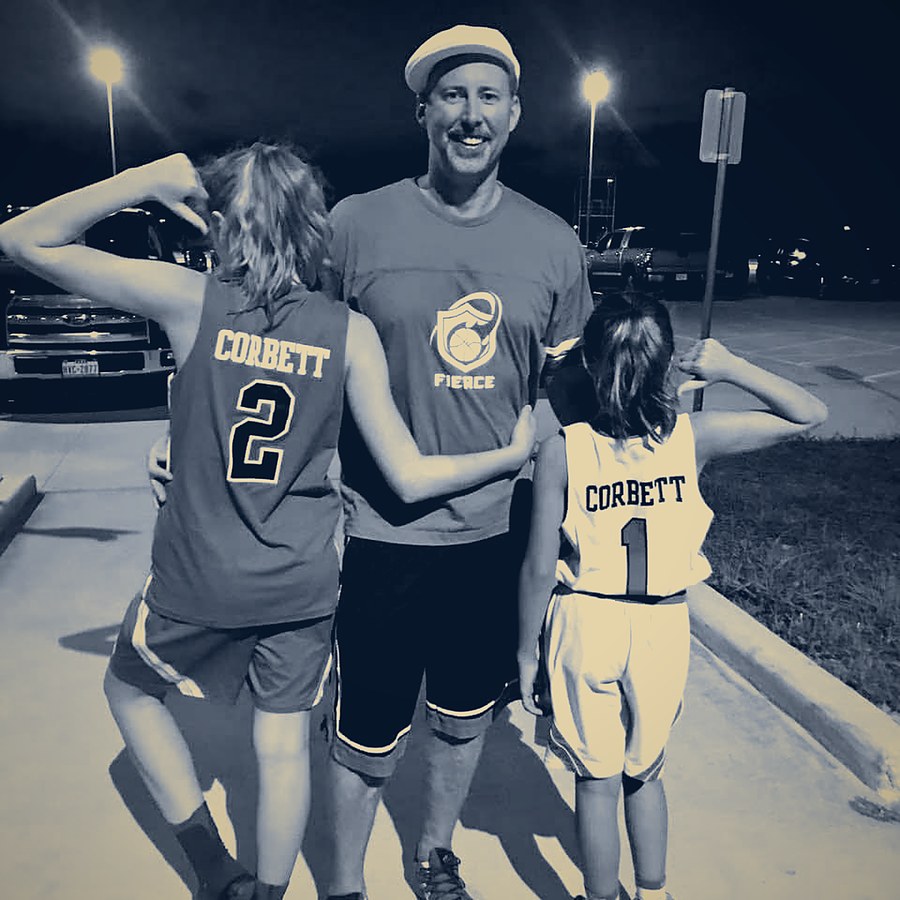
I’m Chris Corbett. I coach in Austin. I played college ball at the NAIA level. I’ve put roughly 100 players into college programs across D1, D2, D3 and NAIA.
Coached at Snow Valley under Don Showalter
FIBA masters competitor · Trains European clubs
Dad of two daughters who played college basketball
I’ve learned this game from four sides — as a player, a coach, a trainer, and a parent watching my own kids go through it. That’s where the system came from. Not a franchise manual.
Most youth trainers teach what they were taught. I teach what the governing bodies publish, from the people who publish it — and then I keep going.
I’ve sat where you’re sitting. Writing the checks. Wondering if any of it was working.
13 — Fit
Who this is for
- Middle schoolers, boys or girls, who want to play in high school
- Kids who’ll show up and work — including on the boring stuff
- Parents who want a real standard, not a highlight reel
- Anyone shopping for viral dribble moves
- Families who need a flexible, drop-in, make-it-up-later schedule. This is a reserved spot, not a punch card
- Families who want a guarantee their kid starts varsity. I can’t sell that and I won’t
- Kids who aren’t ready to be coached yet
14 — The guarantee
Come to the
first session
If it isn’t the most organized, most useful hour of basketball your kid has had, tell me and I’ll refund the month. No argument. No awkwardness.
I’ll guarantee the work. I won’t guarantee playing time. Nobody honest will.
Venmo me $220 @Christopher-Corbett-13 or Zelle @ 512-921-4444. Note player name and grade, your name and phone number.
15 — Questions
Straight answers
Can 90 days really change anything before tryouts?
Not everything. Enough. In 90 days a kid can fix a shot, add a finish with the off hand, clean up jump stops and pivots, and learn to talk on defense. Coaches notice all four inside ten minutes of a tryout. What 90 days won’t do is make a kid taller or undo two years of nothing — I’ll tell you straight where your kid actually sits.
My kid already plays select. Is this redundant?
No. Select teams compete. We train. USA Basketball wants about 60% of this age band’s time in individual skill work. Most select schedules flip that.
Is my kid too far behind?
Probably not. We test where they actually are and build from there. That’s what the scorecard is for.
Should they specialize in basketball now?
No. And I’ll say it out loud even though it costs me. USA Basketball says delay single-sport specialization until at least 14. Play other sports. It makes them better at this one.
What if we miss a session?
You miss it. No makeups, no credits. Same as your kid’s middle school team — practice happens whether they show up or not. I’m paying for the floor either way, and your spot is held either way. That’s what holding it means. Give me a heads up when you can.
What do they bring?
Ball, water, shoes that fit. That’s it.
Your kid is going to spend the next 90 days getting better at something.
Make it the things a coach can see from the sideline in ten minutes.
Purpose.
Power.
Claim a Spot
Questions first? Text me. 512-921-4444